Monday, 13 May 2013

Tiny Stars with a Big Flares


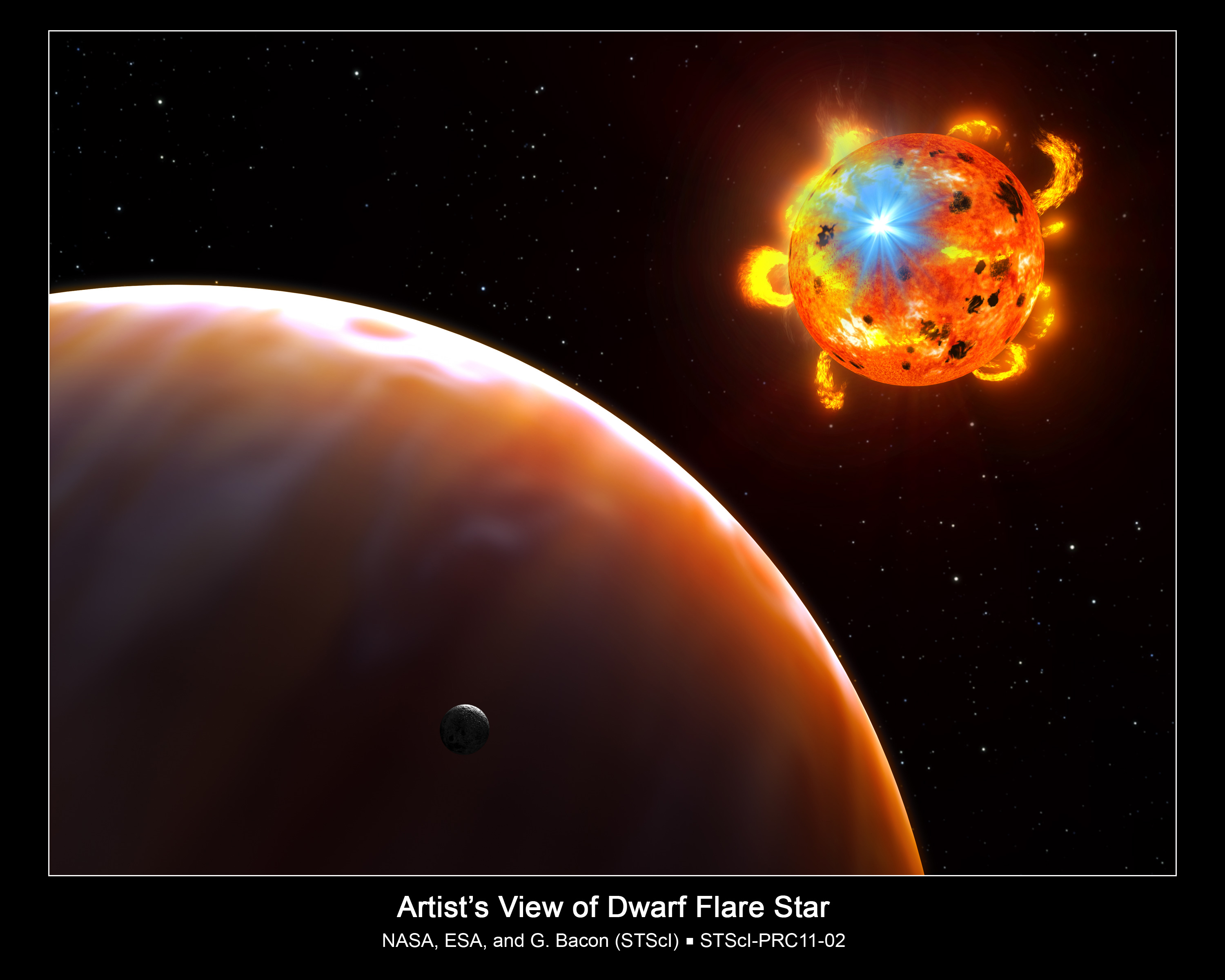
This is an artist's concept of a red dwarf star undergoing a powerful eruption, called a stellar flare. A hypothetical planet is in the foreground. Credit: NASA/ESA/G. Bacon (STScI)

For a long time, astronomers have known that stars often have troubled childhoods. They suffer from frequent and violent flares. But eventually, as they settle onto the main sequence, stars grow out of their destructive ways, which is thankful for us since large flares could do some serious damage to our biosphere. A new study confirms expectations that some stars never outgrow their roguish ways and that the smallest stars can be prone to the most frequent flares.


The study uses data from the Sagittarius Window Eclipsing Extrasolar Planet Search (SWEEPS) survey conducted by the Hubble Space Telescope. This survey was conducted over a seven day period in 2006 and originally designed to search for transiting planets by repeatedly imaging over 200,000 stars for sings of transits. However, since the exploration contained so many red dwarf stars, the smallest and most common stars in the universe, a team led by Rachel Osten of the Space Telescope Science Institute was able to use it to constrain the rate of flares on these diminutive stars.

The team eventually discovered 100 stellar flares, some of which increased the overall brightness of their parent star by as much as 10%. In general, most flares were short, lasting on average a mere 15 minutes. Some stars flared multiple times. These flares weren’t limited to simply young stars, but also, highly evolved stars, including several variable stars which appeared to flare more often.

“We discovered that variable stars are about a thousand times more likely to flare than non-variable stars,” Adam Kowalski, another team member, says. “The variable stars are rotating fast, which may mean they are in rapidly orbiting binary systems. If the stars possess large star spots, dark regions on a star’s surface, that will cause the star’s light to vary when the spots rotate in and out of view. Star spots are produced when magnetic field lines poke through the surface. So, if there are big spots, there is a large area covered by strong magnetic fields, and we found that those stars had more flares.”

Part of the reason that dwarf stars are though to flare more comes from the fact that they have deep convection zones (shown by their lack of lithium in the photosphere which is destroyed by convection which drags it to depths hot enough to destroy it). This bulk movement of ionized particles creates a dynamo and strong magnetic fields on the star. When these fields become especially tangled, they can snap and spontaneously reform in a lower energy state. The energy lost is dumped into the stars outer layers, heating them with tremendous amounts of energy and releasing large amounts of ultraviolet, X-ray, and even gamma radiation as well as charged particles. In more extreme circumstances, the fields don’t immediately reform but swing outwards as they unwind themselves, dragging large amounts of the star with it, and flinging it outwards in a coronal mass ejection (CME).

One of the results of the enhanced magnetic activity is a larger number and size of sunspots. According to Osten, “Sunspots cover less than 1 percent of the Sun’s surface, while red dwarfs can have star spots that cover half of their surfaces.”

ASTRONOMERS DISCOVER PLANET MADE OUT OF DIAMOND!

Why not visit 55 Cancri e? It's a mere 40 light years away from Earth, completely orbits its sun in a blisteringly quick 18 hours and its surface temperature can reach a pleasant 3,900 degrees Fahrenheit. Oh, did I mention that scientists believe that at least a third of the planet is made of diamonds?

Discovered back in 2011 when it crossed in front of its star, 55 Cancri e is packing some serious booty. It's roughly twice the size of Earth, but estimates put its mass at roughly eight times that of our planet. The mass estimate, when checked against the planet's radius and orbital difference, have allowed a team of astronomers to determine its chemical make up with the aid of computer modeling tools. Their best guess? It's mostly made of bling. Previously, scientists believed the planet contained substantial amounts of super-heated water.

"The surface of this planet is likely covered in graphite and diamond rather than water and granite," explained Yale researcher, Nikku Madhusudhan. "Science fiction has dreamed of diamond planets for many years, so it's amazing that we finally have evidence of its existence in the real universe. It's the first time we know of such an exotic planet that we think was born mostly of carbon-which really makes this a fundamental game-changer in our understanding of what's possible in planetary chemistry."

This isn't the first "diamond planet" astronomers have come across, but it's the first time one has been observed in a solar system similar to our own. The system's sun, 55 Cancri A, is actually visible to the naked eye and can be seen in the constellation of Cancer. According to Madhusudhan, the discovery of the planet's jeweled interior challenges commonly held assumptions about the composition of Earth-like planets.
image

What Does the Moon Look Like from Space?


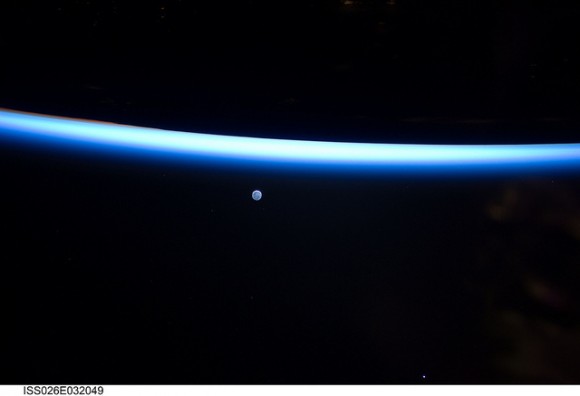
Earth's thin line of atmosphere and a crescent moon are featured in this image photographed by an astronaut from Expedition 26 aboard the International Space Station. Credit: NASA. Click for larger version
Ah, the Moon! Earth’s constant companion and the subject of songs, poetry, and many an astrophoto here on Universe Today. But we always gaze upon the Moon under the cover of Earth’s atmosphere. Does it look any different from up above the world so high? Astronauts from the ISS have taken plenty of pictures of the Moon, and here are a couple recent and notable lunar images. The one above is of a crescent Moon taken in March of this year (2011) — notice the bright crescent sliver present even while the entire moon is visible. Here, the Moon looks teeny tiny. Below is another view of a bigger, but still crescent Moon as seen from the ISS.
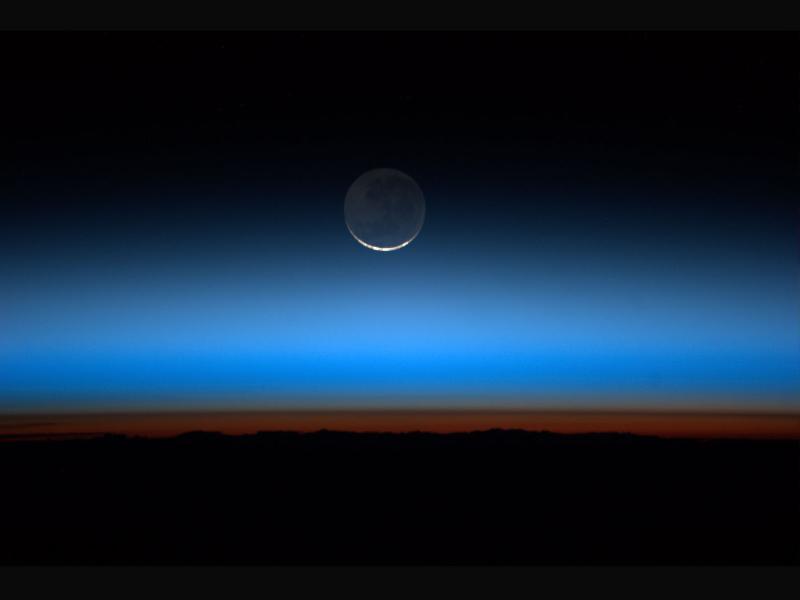
The Moon as seen by astronaut Ron Garan on the ISS on July 31, 2011. Credit: NASA/ Ron Garan
Expedition 28 astronaut Ron Garan took this image just a few days ago on July 31, 2011 from the International Space Station. This is such a stunning image, it was featured on NASA’s Image of the Day Gallery. Garan noted the view saying, “We had simultaneous sunsets and moonsets.” For anyone in orbit, this extraordinary event is a daily occurrence. Since the station orbits the Earth every 90 minutes, each day the crew experiences such a view about 16 times a day.


Read more: http://www.universetoday.com/88055/what-does-the-moon-look-like-from-space/#ixzz2TBpWIE1Y